
To celebrate Scottish Apprenticeship Week from 2 to 6 March, we are highlighting the journeys of six former apprentices who have built remarkable paths in the food & drink sector.
We asked each of them six key questions to uncover how their apprenticeship has provided the foundation for their success.
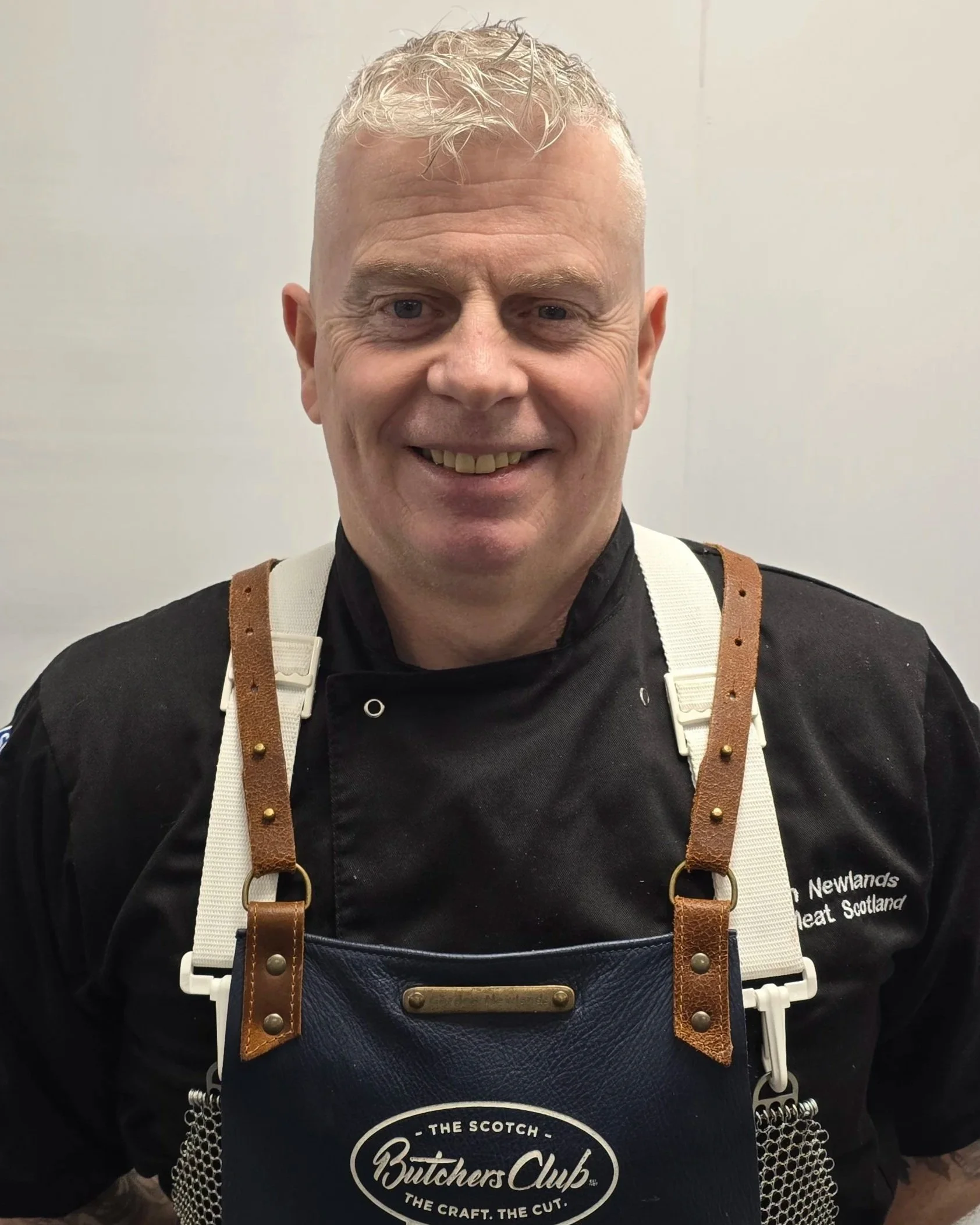
Gordon Newlands, Brand Development Manager, Quality Meat Scotland (QMS)
“A skilled trade - whether it be a butcher, fishmonger, engineer, baker, electrician, joiner - can lead to a marvellous opportunity to create a lifestyle for yourself and your future career path.”
The starting point: what first attracted you to an apprenticeship in the food and drink industry, and what was your very first role?
On leaving school without any qualifications at 16 - which my father who was Principal Teacher of Technical at Galashiels Academy was not pleased about - I really didn’t know what I was going to do.
I left school and walked down the street to the town and was considering going to the Careers Unit to join the Army as I felt I had to work!
However, on passing a window which had an advert for a “butchery apprentice” placed in it, I went in and spoke to the owner and started work some two hours later.
On going home and announcing my apprenticeship to my parents, all was forgiven. My work ethic was there as I had two paper rounds and knew that if I worked hard I was going to earn money.
So really by default I fell into the food industry, as in those days all that was promoted by careers were the woollen mills which were incredibly busy but not a life for me.
My first weekly pay was £12.70 in 1985 and my mother and father took £5 board. At the time I felt that was harsh but it taught me to balance, save and look after the finances!
The learning curve: what was the most valuable skill you learned as an apprentice that you still use in your work today?
You never stop learning in the red meat industry but I suppose - listening - whether it be to your boss or a customer is a crucial skill that never leaves you.
I also think that I learned so much more in how to interact with customers, remembering their names, addressing them as mister or missus until told otherwise.
Weights are important to learn so you can quickly know what the customer is asking for – I can still remember that 226 grammes equals half a pound!
Speaking to people how you would wish to be spoken to and remembering that these customers pay your wages was really important. Listening is still crucial in my role as to gather information from members, I have to listen carefully to what they are explaining.
The career ladder: can you briefly describe your journey from apprentice to your current position?
I was a bit of an athlete when I was young so had to balance training with work, which I did do very well. I was Scottish men’s 400m athletics champion in 1992 & 1993 where I lifted the Eric Liddell Trophy (a real hero of mine)!
I gained my Apprenticeship, my level 2, then level 3 and then achieved my Scottish Federation Diploma in several butcher shops over a five-year period. Five years was the term of the apprenticeship and the owner of the business only signed you off when he thought you were ready. Advanced Hygiene and Hazard Analysis Critical Control Point certification gained along the way.
I moved companies to better myself and learn more as my brain was a sponge ready to soak up knowledge from butchers I worked with (that listening skill, once more)!
I then managed a shop at 23 years old which turned over £1.5million per annum and had nine staff, many older than myself. This was a challenge to speak to men much older than myself and arrange work orders and flow, however, it has stood me in good stead and I now have no such fear of speaking to anyone.
I then worked in education where I assessed apprentices and progressed them through their SVQs. I then ran a shop for nine years with five staff which was a very successful business.
A slight change from the tools was next when I went on to work for an American flavourhouse down in Leeds which supplied the red meat retailer. I worked with new product development chefs to develop products for retailers.
Then, I came back to Scotland to work for QMS as Brands Development Manager and head up the Scotch Butchers club and Scotch Beef Clubs – where I work now.
The industry impact: why do you think the food and drink sector offers such a strong career path for ambitious young people in Scotland?
Our sector offers clear progression with real purpose – roles include science, engineering, marketing, red meat processing, farming, finance, leadership, new product development and foodservice – to name but a few!
For me, too much emphasis is on further education in Scotland. I am sure there are plenty of young people both male and female that would prefer to learn a skilled trade. And I cannot emphasise enough how important a trade food and drink is in Scotland.
You earn while you learn and all the while you are gaining knowledge and experience for your future careers. Whether it be in the red meat industry, or drinks industry in distilling, there are clear career pathways that allow young people and career changers to learn a skilled trade, which not only benefits themselves but also the local communities and economic structure of Scotland.
Once gained, these skills can be transferred anywhere in the world. We want people to stay in Scotland but many have valued careers abroad also, as global demand is massive.
The myth-buster: what is one thing you would say to a parent or teacher who thinks apprenticeships are a “second-best” option to university?
“How wrong you can be.” A skilled trade - whether it be a butcher, fishmonger, engineer, baker, electrician, joiner - can lead to a marvellous opportunity to create a lifestyle for yourself and your future career path. The global desire for skilled men and women is simply enormous.
Scotland has a rich history of producing incredibly skilled craftsmen and women.
I liken our incredible young people to our famous tartan with the career paths being the “warp”, and the skill of the person the “weft” of the cloth. Combined, it creates a superb fabric which represents Scotland on a global stage.
We should be incredibly proud of our young people who maybe didn’t have the most desirable time in school but have turned their minds to a skilled trade which is the very backbone of Scotland.
The future: what is your ultimate career goal, and how did your apprenticeship give you the foundation to reach it?
My career goal was explained to me by my late father. He simply stated: “If you are to be a butcher, then be the best butcher that you can be.”
My apprenticeship, which I loved, gave me the foundation blocks to cover many continents, meet many people, and have the confidence to represent my trade at home and abroad in my role as Brands Development Manager for QMS.
I suppose my network is a global one but although the red meat industry is a global industry it seems quite intimate too, when meeting colleagues and friends from other countries.
If someone asked me would I change the pathway - I would not change a single thing!
Fifty-eight years old, still learning, still loving my trade, still pushing boundaries, still promoting our Scotch brands and still enjoying life!
Voices of experience
The campaign is part of Scottish Apprenticeship Week (2–6 March 2026) and aims to show that an apprenticeship is an effective ladder to a successful, long-term career.
Our case studies feature a diverse group of professionals at various stages of their careers:
Alan Baxter: managing director, Rowan Glen
Victor West: CEO of Macsween Allan Food Group and non-exec director at Associated Seafoods
Gordon Newlands: brand development manager, Quality Meat Scotland (QMS)
Robbie Hughan: assessor, Craft Skills Scotland
Donald McInnes: food and nutritionist, West Dunbartonshire Council
Lauren Boyer: quality and technical apprentice and marketing assistant, Rowan Glen
The stories of these individuals show that an apprenticeship is not just a route to a first job, but the foundation of a lifelong career. It develops the key transferrable skills needed to progress in life.
There are many exciting reasons to work in food and drink. It’s rewarding, you can make a difference and there truly is a job for everyone. Whatever the uncertainties about the years ahead, people will always want to eat and drink – and to eat and drink well. There will always be careers to get your teeth into.
An apprenticeship is the perfect entry point for those looking to build a secure and successful future in this vital industry.
Want more inspiration about a career in food & drink in Scotland? Watch this short film or visit our career information resource.